Choosing a Peptides Blog You Can Trust: How to Separate Evidence From Hype
How to choose a peptides blog you can trust: six signs of reliable peptide content, the evidence ladder, red flags and a five-minute way to check any claim.

The Short Answer
A good peptides blog links to original studies, labels how strong each piece of evidence is, names the exact molecule and form being discussed, shows who wrote and reviewed each article, corrects mistakes openly, and does not sell the products it writes about. Those six signals separate education from marketing in a field crowded with hype.
Peptides are everywhere online right now. Some of the most important medicines of the decade are peptide-based, and genuine research is moving quickly. At the same time, social feeds and search results are full of confident claims about peptides for healing, longevity, muscle, skin and sleep, many with little or no human evidence behind them. If you want to learn about peptides, where you read matters as much as what you read.
On this site we usually write about lozenges, nicotine replacement and practical product guidance, and the same principle runs through all of it: good health information shows its sources and is honest about its limits. This guide applies that principle to peptide content. We will cover what a trustworthy peptides blog looks like, how to judge the evidence behind any claim, red flags that should make you close a tab, and a few places to start reading.
Why Peptide Content Needs Extra Scrutiny
Peptides sit at an awkward intersection. Real, approved medicines such as insulin and the newer GLP-1 based drugs are peptides. So are the collagen peptides in supplement powders. And so are a long list of experimental compounds that are being studied, or that are sold online with “research use only” labels and no approval for human use.
Because one word covers all of these, it is easy for content to borrow credibility from one category and apply it to another. A post might point to strong trial results for an approved medicine and then imply that an unapproved compound works the same way. Or it might cite a promising mouse study as if it settled a human question. A good peptides blog keeps these categories clearly separate; a weak one blurs them.
Six Signs of a Peptides Blog You Can Trust
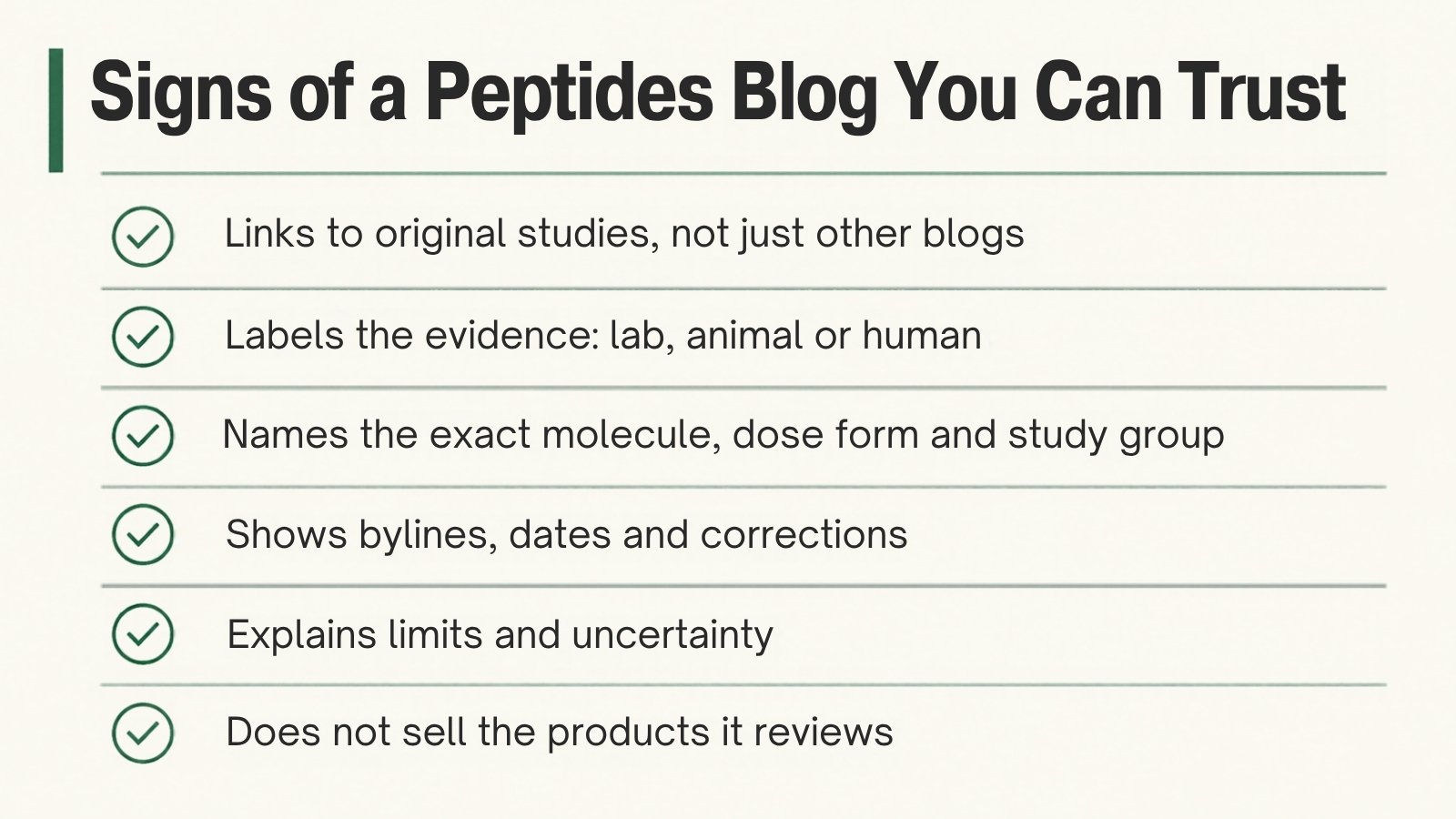
1. It links to original studies
The best articles link straight to the paper, trial registry entry or official document they are describing, not just to another blog. That lets you check whether the summary matches the source. If you want to look up studies yourself, the National Library of Medicine’s PubMed database of biomedical literature is free and is where most peptide research abstracts can be found.
2. It labels the type of evidence
Not all studies answer the same question. Laboratory and cell studies explore mechanisms. Animal studies test ideas in living systems. Human observational studies and case reports describe what happened to people. Randomized controlled trials test whether a treatment causes an effect. A trustworthy blog tells you which kind of evidence it is describing, so you can judge how far to trust it.
3. It names the exact molecule, form and population
“Peptides help with healing” is meaningless without specifics. Which peptide? Given how: injected, swallowed, applied to skin? Tested in whom? Results from one molecule, dose form or group of people do not automatically transfer to another.
4. It shows who wrote it and when
Look for bylines, publication dates, update dates and a visible corrections policy. Science changes, and honest publications say when an article was revised and why.
5. It explains limits and uncertainty
Good writing about research tells you what a study did not show as clearly as what it did. If an article contains no caveats at all, that is a warning sign rather than a sign of confidence.
6. It does not sell what it reviews
Conflicts of interest are not automatically disqualifying, but a site that both “reviews” peptides and sells them, or earns commission on every recommendation, has a built-in reason to be optimistic. Independent educational sites remove that pressure.
A Peptides Blog Example: How The Peptides Blog Approaches It
It helps to see these principles in practice. The Peptides Blog is an independent educational publication that covers peptide biology, collagen, skin and hair research, and peptide medicines such as semaglutide and tirzepatide. Its published editorial standards on sourcing, evidence labels and corrections commit to linking original sources, labelling laboratory, animal and human evidence, using honest bylines, and dating corrections. The footer of every page notes that it is independent education and sells no products.
Its articles also open with a short “study details” panel that states the evidence stage, the regulatory context and the known limits before you read a word of the main text. That is a useful habit for any reader to borrow: ask those three questions first. You can see how the publication grades studies on its page describing its evidence method.
Understanding the Evidence Ladder
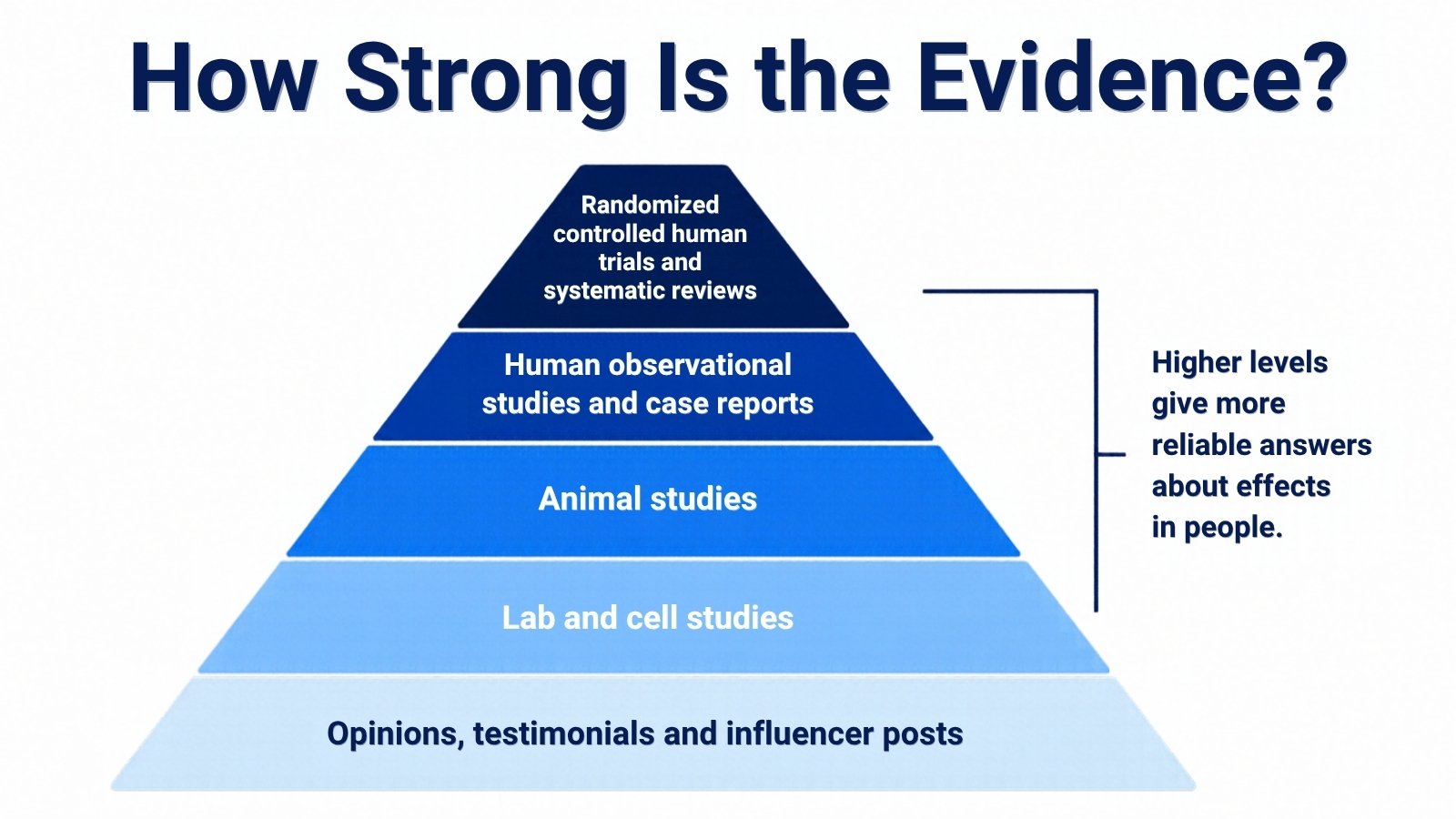
Think of evidence as a ladder. At the bottom are opinions, testimonials and influencer posts. They can raise interesting questions but cannot answer them. Above that are laboratory and cell studies, which show what a molecule can do in a dish. Then animal studies, which test effects in living organisms that may or may not respond like humans. Next come human observational studies and case reports, which describe real people but cannot easily separate cause from coincidence. Near the top are randomized controlled trials, which compare a treatment against a control group, and systematic reviews that combine many trials.
A lot of peptide enthusiasm online rests on the lower rungs. That does not make it worthless, but it does mean claims about what happens in people are often running ahead of the data. This short video gives a clear, general introduction to research methods, including why case studies and experiments answer different kinds of questions:
The Kinds of Peptide Content You Will Find Online
It helps to recognise what kind of source you are reading before you judge it. Peptide content online tends to fall into a handful of types, each with its own strengths and blind spots.
Academic and government sources. Journal articles, trial registries and agency pages are the primary record. They are reliable but often dense, and they rarely put findings into everyday language.
News coverage. Health journalism can be excellent, but headlines compress nuance, and articles are sometimes based on press releases rather than the full paper.
Clinic and telehealth websites. These may explain treatments they offer. They can be informative, but they have a commercial interest in presenting their services favourably.
Vendor and research-chemical sites. Sites selling peptides, especially those labelled for research use only, have the strongest incentive to overstate benefits and the weakest accountability for accuracy.
Influencers and podcasts. Personal experience and enthusiasm can be engaging, but anecdotes cannot show what a peptide does across many people, and sponsorships are common.
Independent educational blogs. At their best, these translate primary research into plain language while keeping sources, limits and status visible. That is the gap a good peptides blog fills.
How to Read a Study Abstract
When an article links to a study, the abstract is usually the quickest way to check its claims. Most abstracts follow the same structure, and a few minutes is often enough to spot a mismatch.
Background or objective tells you what question the researchers asked. Check that it matches the claim you are investigating.
Methods tell you who or what was studied. Look for words like “mice,” “rats,” “cell culture,” “in vitro,” “case report,” “randomized” and “placebo-controlled.” These alone tell you most of what you need about the strength of the evidence.
Results give the main findings. Note the size of any effect and how many participants were involved. A small study with a large effect deserves more caution than a large study with a modest effect.
Conclusions summarise the authors’ interpretation. Compare this with how the blog or post described the study. If the post claims far more than the authors did, you have found the problem.
Understanding Conflicts of Interest
Most published studies include a funding statement and a list of author conflicts. Industry funding is common and does not automatically invalidate a study, especially for large, well-designed trials that regulators also review. But funding can influence which questions get studied and how results are presented. The same logic applies to blogs. A site that earns money from the products it discusses is not necessarily wrong, but it has a reason to be optimistic, so its claims deserve independent checking.
From Lab Bench to Social Post: How Claims Get Distorted
A typical peptide claim travels through several steps before it reaches you. A research team publishes a study with careful caveats. A university or company issues a press release that highlights the most exciting result. A news outlet writes a story from the press release. A blogger summarises the news story. An influencer turns the blog post into a short video. At every step, details such as “in mice,” “in a small group,” “for 12 weeks” or “compared with placebo” tend to fall away. By the end, a cautious finding can sound like a breakthrough. Going back to the original source is the simplest way to recover what was actually found.
Red Flags in Peptide Content
Watch for these patterns. One alone is reason for caution; several together usually mean marketing rather than education.
Miracle language. “Regenerates any injury,” “reverses aging,” “melts fat with no effort.” Real research rarely produces sweeping, side-effect-free results.
Dosing protocols for unapproved compounds. Detailed injection schedules for substances with no approved human use, often presented as if they were routine.
“Research use only” next to human benefits. A product labelled not for human use, promoted with claims about human effects, is a contradiction worth noticing.
No sources, or sources that do not match. Claims with no citations, or citations that turn out to describe a different molecule, a different dose form or an animal study.
Influencer authority. Personal transformation stories presented as proof. The Peptides Blog’s look at what the evidence says about popular influencer peptide claims shows how far some of these stray from the data.
Affiliate links on every claim. Not automatically dishonest, but a strong reason to check the evidence independently.
Trustworthy vs Untrustworthy Peptide Content
| Feature | Trustworthy peptides blog | Marketing-driven content |
|---|---|---|
| Sources | Links to original studies and official records | No links, or links to other promotional sites |
| Evidence labels | States whether evidence is lab, animal or human | Treats all evidence as equal |
| Specificity | Names molecule, dose form and study group | Talks about “peptides” in general |
| Regulatory status | Distinguishes approved, investigational and compounded | Blurs or ignores status |
| Limits | Explains what a study did not show | No caveats |
| Business model | Independent, no products sold | Sells or earns commission on products discussed |
How to Check a Claim Yourself in Five Minutes
You do not need a science degree to sanity-check a peptide claim. Try this quick routine.
Step 1: Identify the exact molecule. Write down the specific name. If the article does not give one, that is your answer about its reliability.
Step 2: Find the study. Search the molecule name on PubMed. Look at the abstract: was it in cells, animals or people? How many people? For how long?
Step 3: Check whether it is being studied in humans now. A trial registry entry shows planned and ongoing human research, though not results. The Peptides Blog has a practical walkthrough on looking up a peptide’s human trials.
Step 4: Check regulatory status. Is the product an approved medicine for the use being claimed, an investigational compound, a compounded preparation or something sold with no clear status?
Step 5: Compare the claim with the evidence. Does the article’s confidence match what the study actually showed? If a mouse study is being presented as proof of a human benefit, the claim has outrun its evidence.
General Tools for Judging Health Websites
These skills apply far beyond peptides. The National Library of Medicine offers a free tutorial on evaluating internet health information that walks through who runs a site, why it exists, where its information comes from, how current it is and how it handles your privacy. MedlinePlus also maintains a collection of training resources for finding quality health information online, useful for anyone who regularly looks up medical topics.
We apply the same thinking to our own product guides. Our explainer on how nicotine lozenges work, including safe use is an example of the approach: explain the mechanism, cite the evidence, describe the risks and avoid promising more than the research supports. You can find more in our product guides section.
Questions to Ask Before You Act on Anything You Read
Reading about peptides is one thing; acting on it is another. Before you buy a product, start a protocol or change a medicine because of something you read, pause on a few questions. Who benefits if I believe this? Is the product an approved medicine, a food or supplement, or something with no clear status? Has the exact form I am considering been tested in people like me? What are the known risks, and who would I call if something went wrong? Would my doctor or pharmacist agree with this plan if I showed them the article?
If you cannot answer these questions confidently, the safest next step is a conversation with a licensed clinician, not a purchase. Bring the article with you. A good clinician will be happy to look at the source with you and explain where it fits in the wider evidence.
Building a Healthy Reading Habit
A few small routines make it easier to stay informed without getting misled. Follow a handful of independent, well-sourced publications rather than dozens of accounts. Save articles that link to their sources so you can revisit them later. Be wary of content that makes you feel rushed or afraid of missing out. When a new peptide becomes popular, wait for human trial data rather than jumping on early enthusiasm. And treat confident certainty as a red flag in a field where honest experts still talk in probabilities.
Where Peptide Research Is Genuinely Strong
None of this skepticism means peptide science is all hype. Some areas have robust human evidence. GLP-1 based peptide medicines have been tested in large randomized trials for diabetes, weight management and related conditions. Insulin has been a cornerstone of diabetes care for a century. Collagen peptides have a growing body of human trials, with mixed but real findings. A good peptides blog will celebrate genuine advances as clearly as it flags weak claims, because readers deserve to know where the evidence is strong too.
Common Questions About Reading Peptide Content
Are all peptide blogs biased? No. Some are independent and evidence-focused. The six signals above help you tell them apart.
Is a doctor’s blog automatically reliable? Credentials help, but the same tests apply: sources, evidence labels, specificity, limits and conflicts of interest.
Can animal studies be useful? Yes, for understanding biology and deciding what to test in people. They cannot by themselves show what a peptide does in humans.
What if I cannot find any human studies? Then any claim about human benefits is unproven, no matter how confidently it is stated. That is not proof the claim is false, only that it has not yet been tested in the way that matters most for people.
Bottom Line
Finding a good peptides blog is mostly about spotting a few simple habits: linked sources, labelled evidence, specific molecules and populations, visible authorship and corrections, honest limits and no products for sale. Apply those tests to every article you read, and you will be far better protected against the hype that surrounds this fast-moving field.
If you are looking for a place to start, explore peptide benefits and the research behind them at The Peptides Blog’s independent guides. Its guides cover peptide fundamentals, collagen, skin and hair research and peptide medicines, link to original sources, and explain how strong the evidence is. For a broader framework on judging sources, its article on which peptide information sources deserve your trust is worth a read.
Frequently Asked Questions
What makes a peptides blog trustworthy?
It links to original studies, labels whether evidence comes from lab, animal or human research, names the exact molecule and form, shows authors and dates, explains limits and does not sell the products it reviews.
How can I tell if a peptide claim is backed by human research?
Search the exact molecule name on PubMed and read the abstract to see whether the study involved people, how many and for how long. Check trial registries for ongoing human studies.
Are “research use only” peptides safe to use?
Products labelled research use only are not approved for human use and have no verified quality standards for people. Claims about human benefits for these products should be treated with strong caution.
Why do some peptide blogs only cite animal studies?
Often because human studies have not been done. Animal results are useful early evidence but do not show what happens in people.
Is The Peptides Blog independent?
The Peptides Blog describes itself as an independent educational publication that does not sell peptides, provide clinical treatment or offer medical consultations.
What free tools help evaluate health websites?
The National Library of Medicine’s MedlinePlus offers a free tutorial on evaluating internet health information, and PubMed lets you search biomedical studies directly.
Important note
This article is general educational content about evaluating health information. It is not medical advice and does not recommend or endorse any peptide, medicine or supplement. Mention of a publication is for illustration of good information practices only.
Peptide medicines should only be used under the care of a licensed clinician, and products sold for research use are not approved for human use. Regulations vary by country. Talk to a qualified healthcare professional before acting on any health information you find online.

Becky Sanders
More articles by this author